
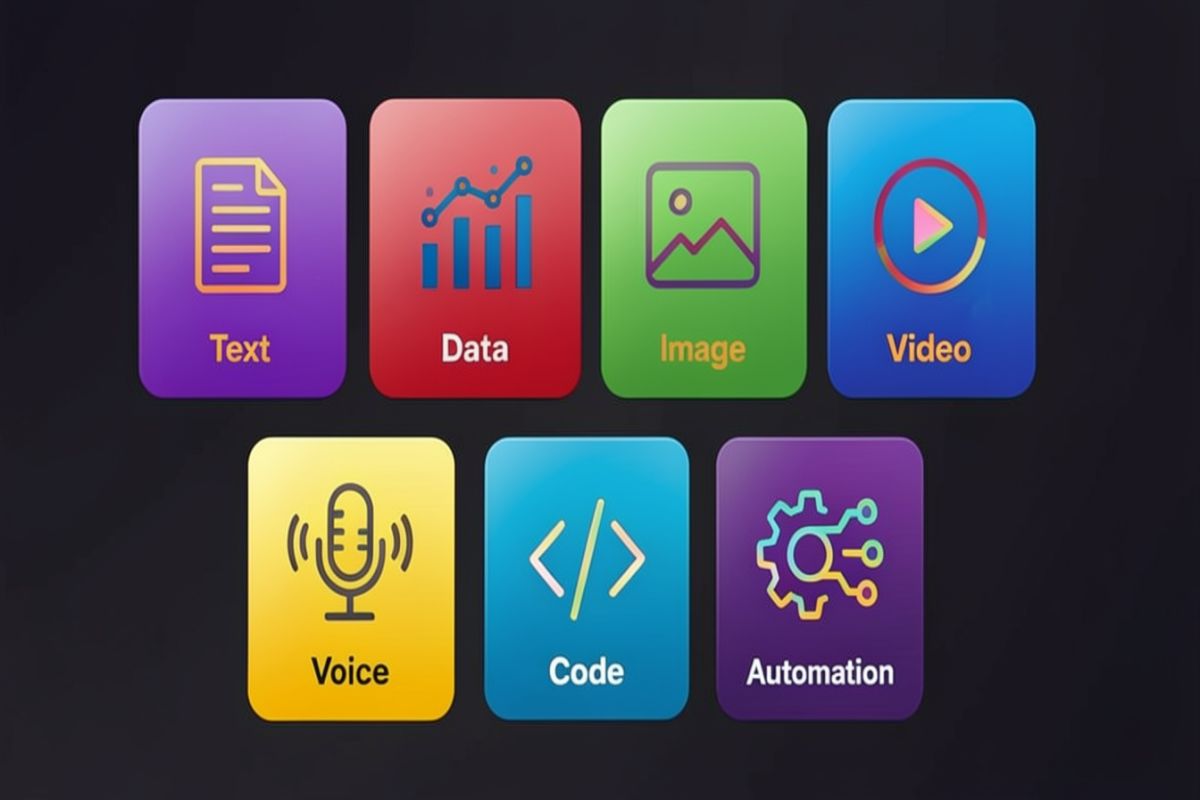
AI Self-Tutorial Master Reference
1. AI Overview
(What AI can do across the 7 core pillars)
|
Pillar |
Capabilities |
|
Text |
Summarization, sentiment analysis, translation, content generation, named entity recognition, code generation, and structured data extraction |
|
Data |
Pattern recognition, anomaly detection, predictive analytics, data enrichment, and structured output generation from unstructured sources |
|
Image |
Generation from text prompts, style transfer, editing, accessible image descriptions, and computer vision analysis |
|
Video |
Generation (Sora 2), closed captioning, remixing, and frame-by-frame analysis |
|
Voice |
Speech-to-text transcription, text-to-speech synthesis with 11+ voice options, real-time voice assistants |
|
Code |
Generation, explanation, debugging, documentation, code review, refactoring, test case creation, and translation between languages |
|
Automation |
End-to-end workflow orchestration (n8n, Make), autonomous agents, RAG pipelines, campaign deployment, and decision loops |
2. AI Ecosystems: East vs West
(Top 15 companies with official website links)
Americas & Allies Hub
|
# |
Company |
Country |
Focus Area |
Official Website |
|
1 |
NVIDIA |
USA |
AI GPUs, CUDA ecosystem, AI infrastructure backbone |
|
|
2 |
Microsoft |
USA |
Azure AI, Copilot, enterprise AI integration |
|
|
3 |
Alphabet (Google) |
USA |
Gemini, TPUs, AI Overviews, Cloud AI |
|
|
4 |
Meta |
USA |
Llama open-source AI, AI ads, recommendations |
|
|
5 |
OpenAI |
USA |
ChatGPT, GPT models, API, reasoning models |
|
|
6 |
Anthropic |
USA |
Enterprise AI, Claude models, safety-focused AI |
|
|
7 |
Amazon |
USA |
AWS AI, Trainium chips, cloud infrastructure |
|
|
8 |
Apple |
USA |
On-device AI, hardware-software integration |
|
|
9 |
IBM |
USA |
Enterprise AI, Watsonx, hybrid cloud AI |
|
|
10 |
Salesforce |
USA |
CRM AI, Einstein GPT, enterprise automation |
|
|
11 |
Intel |
USA |
AI chips, Gaudi accelerators, semiconductor AI |
|
|
12 |
AMD |
USA |
AI processors, GPU accelerators, chip design |
|
|
13 |
TSMC |
Taiwan |
Advanced AI chip manufacturing, semiconductor foundry |
|
|
14 |
Samsung |
South Korea |
AI memory chips, HBM, AI semiconductors |
|
|
15 |
Mistral AI |
France |
Open-source LLMs, European AI alternative |
Eurasia Hub (China, Russia, and aligned markets)
|
# |
Company |
Country |
Focus Area |
Official Website |
|
1 |
Huawei |
China |
AI chips (HiSilicon), AI infrastructure, 5G AI |
|
|
2 |
ByteDance (Doubao) |
China |
Mass-market AI assistant, 150M+ weekly users |
|
|
3 |
Baidu |
China |
ERNIE LLM, search AI, autonomous driving |
|
|
4 |
Alibaba (Qwen) |
China |
Cloud AI, open-weight models, e-commerce AI |
|
|
5 |
Tencent |
China |
WeChat AI, Hunyuan LLM, gaming AI |
|
|
6 |
DeepSeek |
China |
Open-source LLMs, cross-market AI adoption |
|
|
7 |
Zhipu AI |
China |
GLM series LLMs, Tsinghua-backed models |
|
|
8 |
SenseTime |
China |
Computer vision, facial recognition, AI platforms |
|
|
9 |
Kimi (Moonshot AI) |
China |
Long-context AI, consumer chatbot |
|
|
10 |
Yandex (Alice) |
Russia |
Search AI, Alice assistant (71M MAU), YandexGPT |
|
|
11 |
Sber (GigaChat) |
Russia |
AI chat, fintech AI, supercomputers |
|
|
12 |
Xiaomi |
China |
AI-powered devices, smart home, autonomous driving |
|
|
13 |
iFlytek (科大讯飞) |
China |
Intelligent voice, speech recognition, NLP |
|
|
14 |
Horizon Robotics (地平线) |
China |
AI chips for robotics, autonomous driving |
|
|
15 |
Cambricon (寒武纪) |
China |
AI processors, neural network chips |
Quick Regional Snapshot
|
Ecosystem |
Key Traits |
|
West |
Full AI stack control (chips → cloud → UI); dominated by NVIDIA, Microsoft, Alphabet, Meta; strong in framework layer and foundation models |
|
China |
Data-rich, rapid mass adoption; 51 of top 100 AI companies are Chinese; strong in application layer and model quantity; constrained by US chip sanctions; building self-sufficient ecosystem |
|
Russia |
Replicating China's path faster; sanctions created vacuum filled by local products in 2 years |
|
Europe |
Regulate-first approach; developing own projects like Mistral AI and Aleph Alpha |
Sources: IMD Future Readiness Indicator 2025 • a16z Global AI Top 100 2026 • 八月瓜 Global AI Enterprise Innovation Index Report 2026 • TopBrand 2025 China AI Brands • Stanford AI Index
3. Best Practices & Prompt Cheatheets
(Per category: Text, Data, Image, Video, Voice, Code, Automation)
|
Pillar |
Best Practices |
Go-To Prompts |
|
Text |
➤ Define Persona, Context, Task, and Format in every prompt |
"You are a senior technical writer. Summarize this 5000-word report into 3 concise bullet points covering key findings, risks, and recommendations. Format: bullet list." |
|
Data |
➤ Specify exact data format and schema |
"You are a data analyst. Analyze this sales dataset. Identify top 3 trends, 2 anomalies, and provide a confidence score (0-1) for each finding. Output as JSON with fields: trend, evidence, confidence." |
|
Image |
➤ Describe style, composition, lighting, and mood explicitly |
"Generate a product photo of a matte black wireless earbud case. Style: minimalist, soft diffused studio lighting, white background, 1:1 square. No text overlays." |
|
Video |
➤ Storyboard frame-by-frame descriptions |
"Generate a 10-second product showcase video: 3D rotating view of the product, soft pan across features, fade to brand logo. Style: clean corporate aesthetic." |
|
Voice |
➤ Specify voice tone, accent, and speaking pace |
"Convert this text to speech. Voice: Warm, professional female, slight American accent, moderate pace. Emphasize the bolded words: 'This *actually* works.' Output format: MP3." |
|
Code |
➤ Specify language, framework, and version |
"You are a senior Python developer. Generate a function that fetches JSON from an API endpoint every 10 seconds, handles errors, includes cleanup logic. Use async/await, include docstrings. Format: full code with inline comments." |
|
Automation |
➤ Define trigger conditions explicitly |
"Design an automation workflow: When new lead enters CRM → enrich with company data → if company size > 50 → create task for sales rep. Use n8n syntax. Include error handling for enrichment failures." |
4. End-to-End Workflow Example
(Image/Video Ad Creation — AI-Human-Auto hybrid workflow)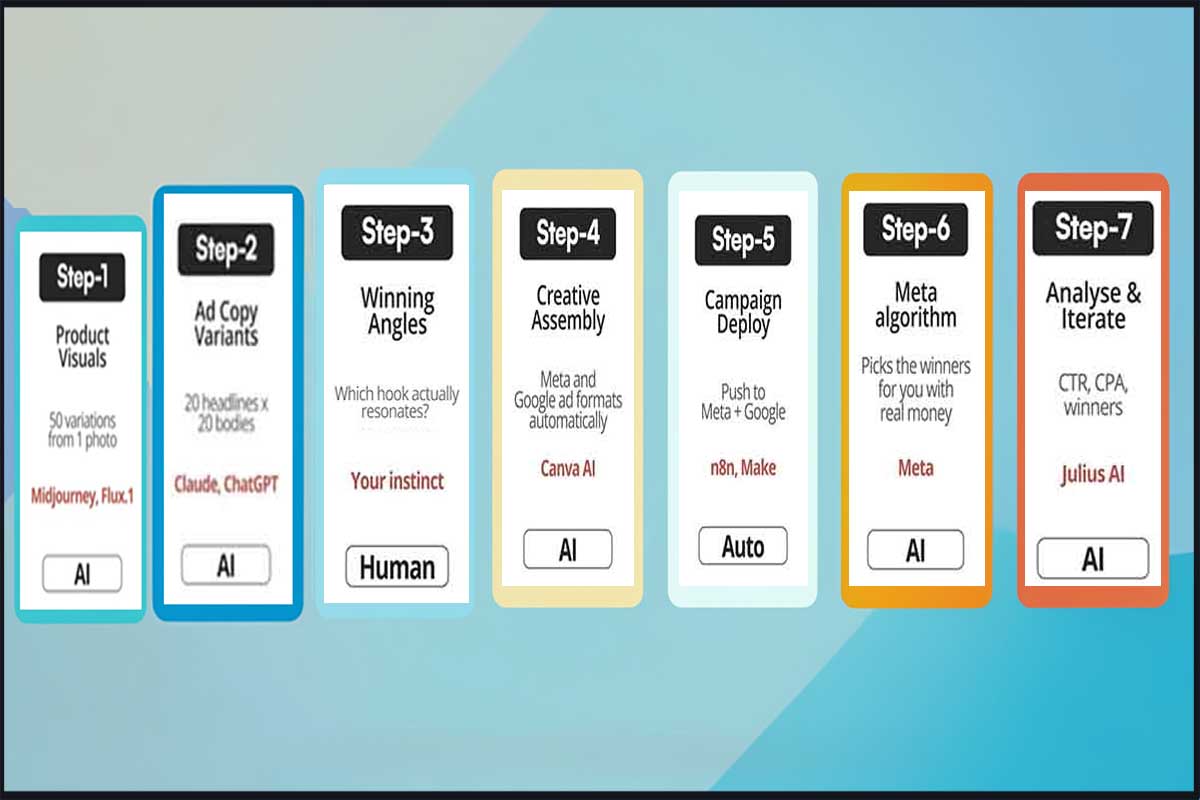
|
Step |
Action |
Tool |
Who/What |
|
1 |
Product Visuals — 50 variations from 1 photo |
Midjourney, Flux.1 |
AI |
|
2 |
Ad Copy Variants — 20 headlines × 20 bodies |
Claude, ChatGPT |
AI |
|
3 |
Winning Angles — Which hook resonates? |
Your instinct |
Human |
|
4 |
Creative Assembly — Meta and Google formats |
Canva AI |
AI |
|
5 |
Campaign Deploy — Push to Meta + Google |
n8n, Make |
Auto |
|
6 |
Meta Algorithm — Picks winners with real money |
Meta |
AI |
|
7 |
Analyse & Iterate — CTR, CPA, winners |
Julius AI |
AI |
5. Cost & Limits Snapshot
*(API pricing tiers, rate limits, free tier quotas — 1-liners per tool)*
|
Tool |
Free Tier |
Paid Tier (Entry) |
Rate Limit |
Notes |
|
OpenAI GPT-5.4 |
None |
$2.50 input / $15 output per M tokens |
Varies by tier |
1M context window; Pro version at $30/$180 |
|
Anthropic Claude Opus 4.6 |
None |
$5.00 input / $25 output per M tokens |
Varies by tier |
Best for complex reasoning; 1M context |
|
Claude Sonnet 4.6 |
None |
$3.00 input / $15 output per M tokens |
Varies by tier |
Best coding cost/quality balance |
|
Claude Haiku 4.5 |
None |
$1.00 input / $5.00 output per M tokens |
Varies by tier |
Budget option for simple tasks |
|
Google Gemini 2.5 Pro |
Limited free tier |
$1.25 input / $10 output per M tokens |
Varies |
1M context at mid-tier pricing |
|
Gemini 2.5 Flash |
Free tier available |
$0.30 input / $2.50 output per M tokens |
Varies |
Fast, cheap, 1M context |
|
DeepSeek V3.2 |
Limited |
$0.26 input / $0.38 output per M tokens |
Varies |
Best cost/quality for open-weight tasks |
|
Mistral Large |
None |
$0.50 input / $1.50 output per M tokens |
Varies |
262K context window |
|
Mistral Small |
None |
$0.15 input / $0.60 output per M tokens |
Varies |
Bottom-tier pricing, good for summarization |
|
Midjourney |
None |
$10/month (200 min) |
Varies |
Image generation; tiered plans available |
Cost Optimization Tips:
Cost Reference: Coding Agent Session
6. Local vs Cloud Tradeoffs
(When to run locally vs use SaaS — privacy, speed, cost, control)
|
Factor |
Cloud (SaaS) |
Local (On-Prem) |
|
Privacy |
Data transmitted to remote servers; risk of breaches or data exposure; reliant on provider security |
Data stays on-device; zero external transfers; 75% of enterprises report improved GDPR/HIPAA compliance |
|
Speed |
500-1000ms round-trip latency; network-dependent |
Sub-100ms inference on edge hardware; 5-10x faster than cloud; ideal for real-time applications |
|
Cost |
Pay-as-you-go with usage-based billing; can spike unpredictably; no upfront hardware |
Higher upfront hardware costs ($500K+ for enterprise); but 30-50% lower TCO over 3 years; no ongoing API fees |
|
Control |
Limited to provider's capabilities; black-box infrastructure; vendor lock-in risk |
Full control over hardware, software, and model versions; direct access for fine-tuning |
|
Scalability |
Limitless scaling on-demand; handles large datasets and millions of concurrent users |
Constrained by local hardware; limited to models under ~7B parameters without high-end servers |
|
Maintenance |
Provider handles updates, patches, and security — zero maintenance burden |
User maintains hardware, security patches, and model updates; ongoing operational overhead |
|
Resilience |
Vulnerable to cloud downtime; requires internet connectivity; single points of failure |
99.9% uptime; works offline; resilient to outages; 40% downtime reduction |
|
Best For |
Large-scale training, complex multi-modal workflows, collaboration across teams, experimentation without upfront cost |
Real-time processing, sensitive data (healthcare/finance), edge devices, autonomous vehicles, industrial automation, IoT |
Key Takeaway: By 2026, local-first AI agents have overtaken cloud agents in enterprise preference due to latency, privacy, resilience, and deployment speed advantages .
7. Fallback Workflows
(Plan A / Plan B / Plan C for when a tool fails or hits limits)
|
Scenario |
Plan A (Primary) |
Plan B (Backup) |
Plan C (Emergency) |
|
LLM API unavailable |
Use primary model (e.g., GPT-5.4) |
Switch to alternative provider (Claude/Gemini) via model routing |
Fallback to locally-run open-source model (Llama/Mistral) on local hardware |
|
Image generation down |
Midjourney web interface |
Flux.1 or Stable Diffusion local instance |
Pre-generated image bank with fallback templates |
|
API rate limit hit |
Implement exponential backoff with retry logic |
Queue requests for batch processing at 50% discount |
Route to budget model with higher limits (e.g., Gemini Flash or GPT-5.4 Nano) |
|
Automation breaks |
Manual run of workflow steps |
Use n8n/Make error-handling nodes with retry |
Execute via human-in-the-loop until automation fixed |
|
Cost overrun |
Enable context compression to reduce input tokens by 50-70% |
Switch to lower-tier model (e.g., Haiku instead of Sonnet) |
Trigger cost alert and pause non-critical workflows |
|
Enrichment failure |
Use deterministic canonical IDs to avoid duplicates |
Return null on low-confidence matches — agent handles gracefully |
Human review of suspect records; fallback to manual CRM update |
|
Hallucination detected |
Chain-of-thought verification — model self-checks its own answers |
Cross-validate with RAG-retrieved ground truth data |
Rollback to previous validated output and flag for review |
Golden Rule: Always have a human-in-the-loop for safety-critical applications. AI-generated code and decisions should be reviewed and validated before deployment .
8. Ethics & Safety Guardrails
*(2–3 non-negotiable rules — copyright, PII, deepfake, hallucination checks)*
|
Category |
Guardrail |
Why |
|
Copyright |
➤ Never prompt for third-party code verbatim; use standard code-checking to detect OSS inclusion |
AI-generated code may violate copyright if the model copied from third-party sources; copyright protection may be lost on fully AI-generated codebases |
|
PII / Privacy |
➤ Never input personally identifiable information or sensitive data into public AI models |
Cloud AI transmits data to remote servers, creating exposure risk; 80% of breaches stem from cloud misconfigurations |
|
Deepfakes |
➤ Label all AI-generated media clearly (C2PA compliance) |
Deepfakes can cause reputational damage, legal liability, and regulatory violations; transparency is non-negotiable |
|
Hallucinations |
➤ Always verify AI outputs against known ground truth |
GenAIs make mistakes and fabricate information confidently; verify everything before taking action |
|
Bias |
➤ Test outputs across diverse scenarios before production |
AI systems inherit and amplify biases from training data; can lead to unfair outcomes in hiring, lending, or targeting |
|
Transparency |
➤ Document all AI usage in workflows — which models, which prompts, which decisions |
Accountability is required for audit trails, regulatory compliance, and stakeholder trust |
Recommended Tools: Infosys Responsible AI Toolkit (open-source) — detects privacy breaches, biased output, copyright infringement, hallucinations, deepfakes, and harmful content .
9. Update Cadence
(How often to revisit this doc — because everything changes fast)
|
Frequency |
Action |
|
Quarterly (Min) |
➤ Review pricing updates (between 2021-2024, cost per M tokens dropped from $60 to $0.06 — a 1000x reduction) |
|
Trigger Events |
➤ New major model release (GPT-5, Claude 5, etc.) |
|
Monthly (Recommended) |
➤ Review API usage and costs — identify optimization opportunities (context compression, model routing) |
|
Annual (Full Review) |
➤ Full document refresh |
Why this matters: The AI landscape is moving at unprecedented speed. From 2021-2024, inference costs dropped 1000x . By 2026, local-first AI overtook cloud in enterprise preference . Companies that don't update their stack quarterly fall behind.
Sources: 10+ authoritative sources including Morph LLM Cost Calculator, Siemens Prompt Engineering Guide, Sparkco Local AI Guide, Explorium Agent Enrichment, Infosys Responsible AI Toolkit, and OpenAI API documentation.



Connect With Us


Connect With Us on Social Media
 +91 9999311584
 +91 9999311584