
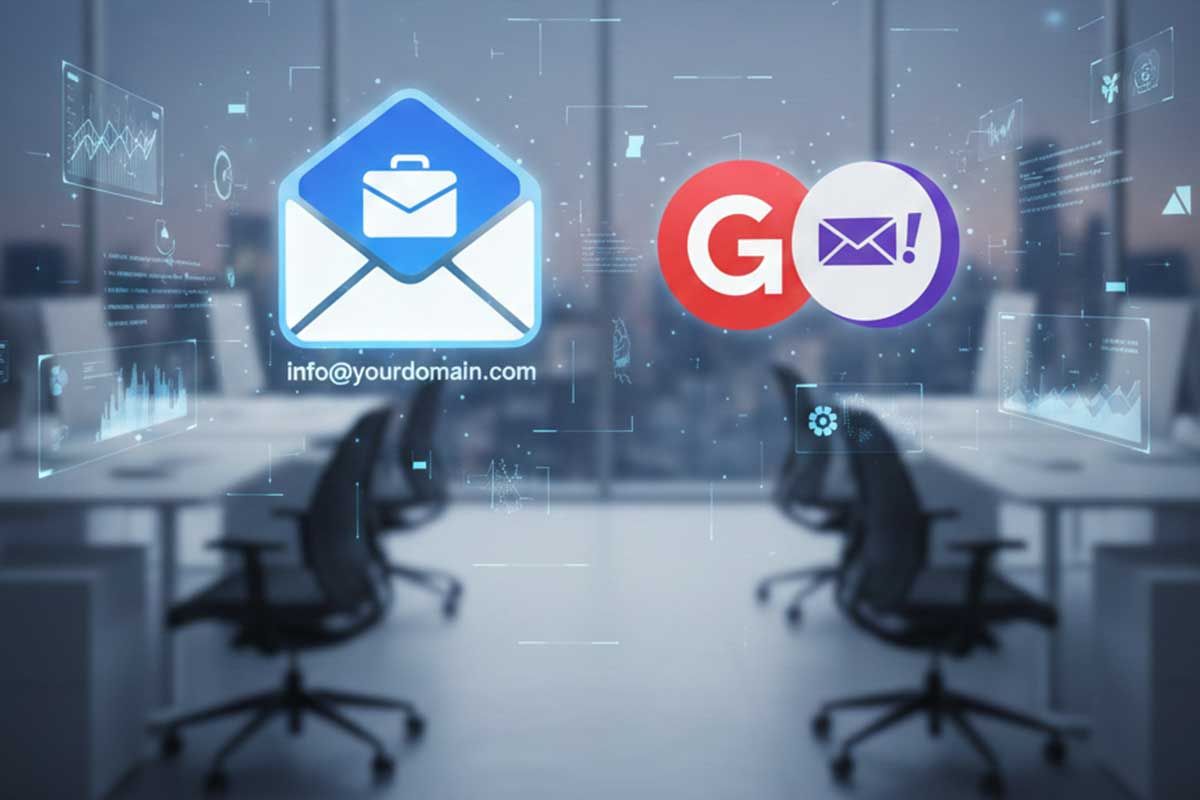
Let’s be honest — in 2025, using a free email like Gmail, Yahoo, or Hotmail for your business is like running a company from a roadside stall while your competitors are inside an air-conditioned office.
Sure, it works…
But it doesn’t look professional, doesn’t build trust, and definitely doesn’t represent your brand.
On the other hand, a business email (example: info@yourdomain.com) instantly tells your audience:
“You’re dealing with a real business, not a random person.”
This article breaks down the difference in a clean, modern, tech-startup style — simple, clear, and practical.
A business email uses your own domain name:
- info@yourbusiness.com
- support@clinicname.in
- booking@travelbrand.com
It shows that the email belongs to a registered brand with a verified website.
A free email uses a general provider’s domain:
- myclinic123@gmail.com
- traveldealz@yahoo.com
- islamicshop@hotmail.com
There is no branding, no identity, and no professional image.
When someone sees an email from:
… they instantly trust the first one.
A domain-based email feels:
Professional
Legit
Serious
Reliable
In industries like healthcare, travel, eCommerce, or Islamic education, trust is everything.
Your domain name appears again and again in your customer’s inbox.
Every time you send an email, you are promoting your brand.
This helps with:
Brand recall
Brand consistency
User confidence
Great brands don’t use free Gmail accounts.
Many free email accounts end up in:
Promotions tab
Spam folder
Or blocked by corporate filters
Business email gets much better delivery because:
✔ It’s verified
✔ It matches your domain
✔ It builds sender reputation
Your website + your email = stronger trust score.
If someone fills a contact form on your website, the automated email should come from:
noreply@yourbusiness.com
not
randombusinessnotifications@gmail.com
Professional emails create a friction-free user experience.
You can create:
This gives the impression of a structured, established business — even if you’re a solo freelancer.
Tools like:
Zoho
HubSpot
Freshdesk
Booking engines
Online forms
Chatbots
… require a domain-based email for authentication and verification.
Free email often fails these integrations.
Free emails are often targeted:
hacking attempts
phishing
password theft
unauthorized login
Business email hosting providers offer:
✔ 2FA
✔ Spam protection
✔ Malware scanning
✔ IP reputation checking
✔ Admin controls
This is crucial for industries handling sensitive information.
Patients trust emails like:
- appointment@citycareclinic.com
It looks professional and secure.
Avoid:
- citycareclinic009@gmail.com
Business email is essential for:
appointments
reports
patient communication
For travel bookings, tickets, and ID proofs — trust matters a lot.
Professional:
- booking@skytravels.in
- support@holidaydesk.com
Avoid:
- skytravels123@gmail.com
Whether you run:
Islamic blog
Halal marketplace
Online Quran course
You need trust and credibility.
Professional:
- info@halalbazaar.in
- support@quraniclearning.org
Avoid:
- halalbazaar786@gmail.com
A professional email boosts your brand immediately, even before you have a big customer base.
Examples:
- info@jaipurbutterchicken.com
- support@mymobilefix.in
✔ Google Workspace (Gmail for business)
✔ Microsoft 365 Business
✔ Zoho Mail (budget-friendly)
✔ cPanel/Hosting-based business email
Each offers:
Professional identity
Spam filtering
Better inbox deliverability
Reliable support
If you’re unsure, I can recommend the right one based on your business type.
Your email address says more about your brand than you think.
A business email:
✔ Builds trust
✔ Looks professional
✔ Improves deliverability
✔ Strengthens your brand
✔ Helps conversions
✔ Makes you appear established
A free email works…
But it doesn’t grow your brand.
If your website has your own domain name, your email should too.
If you need help setting up business email, hosting, domain, or website development, I’m here to guide you. Contact us if you need our help.


Connect With Us


Connect With Us on Social Media
 +91 9999311584
 +91 9999311584